Resettlement and the Ghettos
Created by Ronan A., Ryan L., Lorenzo M. & Max P.
How the Nazis forced Jewish people to leave their homes and live in crowded, walled-off areas called ghettos with terrible living conditions (1939-1943)
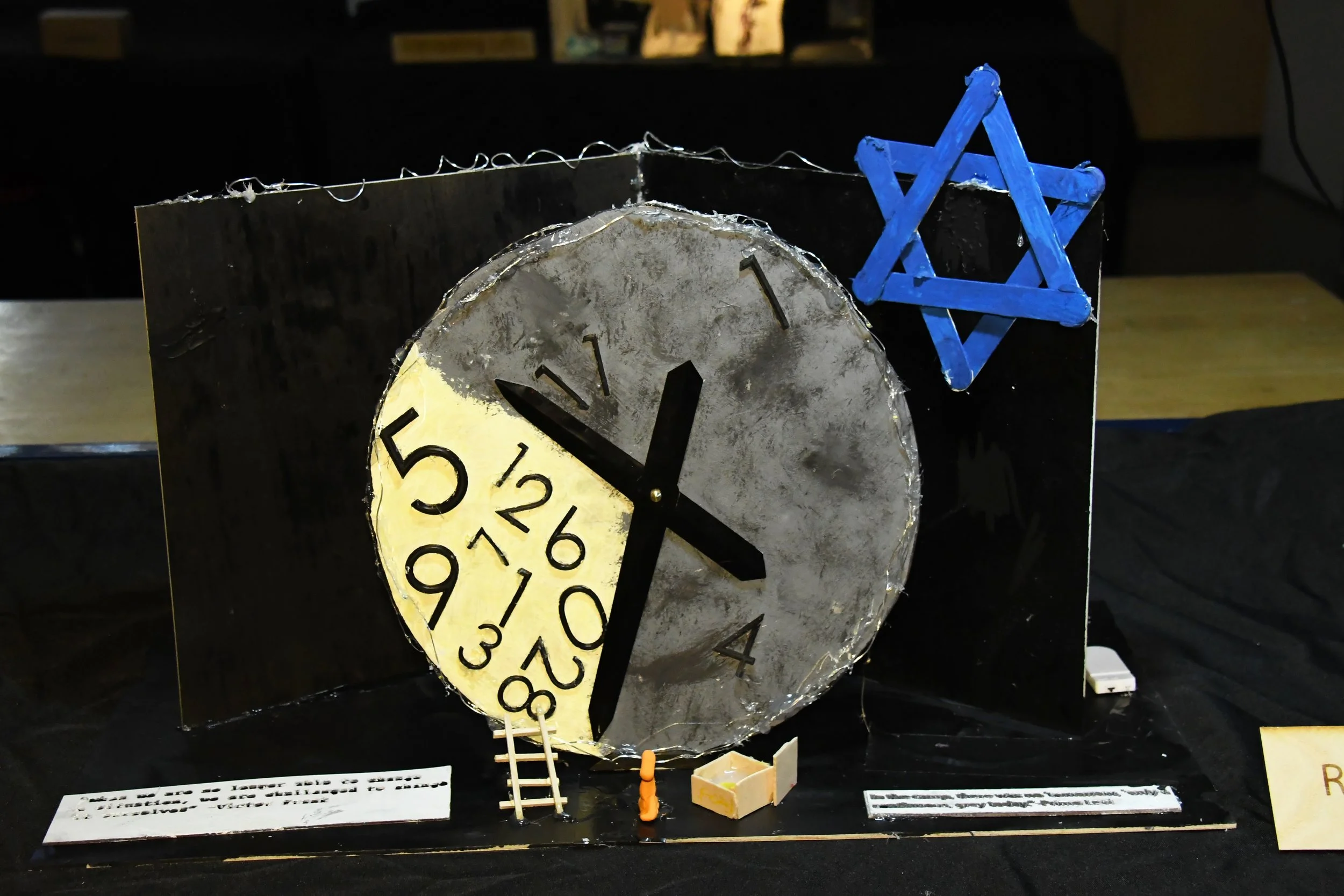
Resettlement
Artist Statement
Our artifact is called the Trap of Time. Our message is even through the cramped conditions of the ghettos, the Jews still found a way to resist and survive.
Even when we are faced with death and darkness, time still goes on, and life endures. Even when there is a lot of struggling resistance, humanity never fully fades away. We want to convey the suffering of the cramped numbers and a little bit of hope and resistance through the numbers escaping, going to their original spots. We choose the clock because a clock is the rhythm of normal life; during the Holocaust, people's lives were distorted. We showed this through the cramped numbers. But the hands still move, showing time continues.
In our research we discovered lots of different forms of resistance, many of which we did not see as humanity pushing through. This will represent the bad conditions of the ghettos. It represents the rhythm of life that is broken. The clock hand, continuing to move despite resistance from the Germans, shows how the Jews push back even when the situation seems dire. Also, we discovered that smuggling was a vital part of surviving in the ghettos, where nearly 80 percent of all food consumed came from there. We showed that humanity pushes for themselves and will steal a minimal amount of food at the risk of their lives.
For materials we used one piece of wood for the base of the clock, we 3D printed the numbers, painted the wood, and built a background where our quotes will be. Some difficult decisions we made were whether or not we needed four pieces of wood or two, either having a background or a floor and a background. We made decisions by confronting each other and talking through it, coming up with a compromise.
One element we used was color. For the ghetto section of the clock, we did a faded yellow. During the Holocaust, the yellow represented hope, and the faded yellow shows how hope was faded but not totally gone. For the empty space, we did a gray color showing emptiness, which was black. We also used contrast. The contrasts we created were gray and white, showing the darkness of humanity while also demonstrating the kindness that shone through with the white.
This memorial matters because it shows the heroic resistance and fighting spirit the Jews had even in the cramped conditions of ghettos and constant surveillance from the SS police. I hope the viewers will take this away as something that shows, even in the darkest of humanity, people still shine their light through and survive.
