Liberation of the Camps
Created by Ben H., Jack J., Burke S. & Benjamin A.
When allied soldiers freed the concentration camps and survivors were finally liberated, showing that hope and freedom were possible (1945)
Body and Soul
Artist Statement
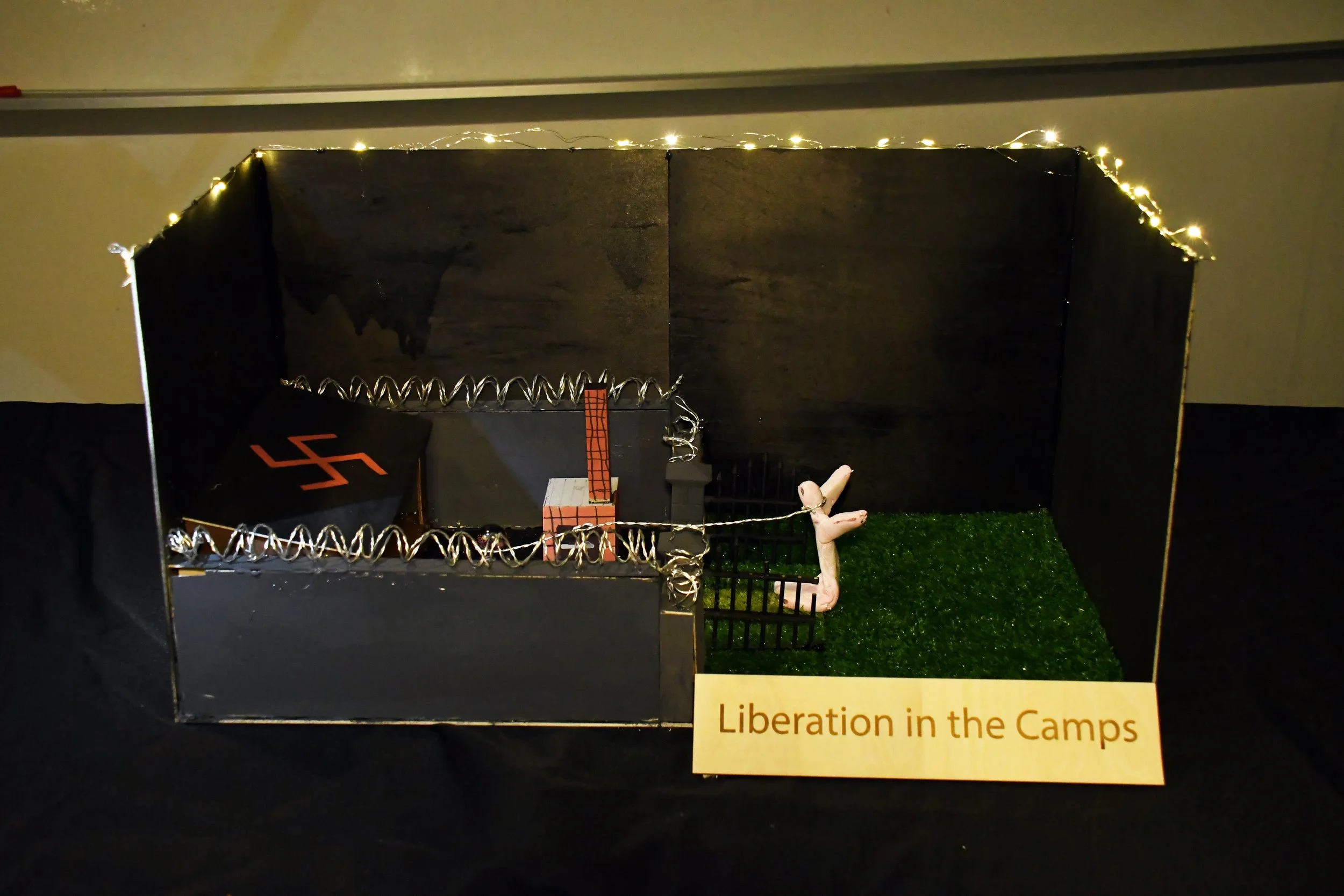
Our artifact on The Liberation of the Camps depicts a liberated prisoner that has just been freed, but his soul, which is left inside the camp, is connected to him by an iron chain. This represents what someone may have felt while leaving the camps, as if they had been separated from their true self, and could not escape the horrors, and memories of the camps because they would forever be a part of them. The liberation process was grueling, and once you were “free” most Jews had no where to go and no one to turn to for support. The Jews that survived and made it to liberation were in terrible health after being starved and brutalized by the Nazis. Once the Nazi’s discovered that Jews were being liberated, the Nazi’s did not want the American troops to discover the reality of the terrors in the camps. They tried to hide as much as possible as quickly as they could. We are not focusing on any one camp specifically, but instead trying to incorporate all the camps.
True humanity is achieved through empathy. Thinking and understanding what other people may have felt during this time period allows everyone to have humanity. We hope that you can feel empathy towards every survivor of the Holocaust, and get a glimpse at what it might have been like to leave the camp. The Swastika, this is the symbol of the Nazis, and every German guard who was a Nazi wore armbands with them imprinted on them. The Swastika appears everywhere throughout the Holocaust no matter what subject you are researching, but they showed up in the camps a lot more than outside. The repetition of the Swastika is to symbolize the immense impact the Nazi’s had on the Jew’s souls. Barbed Wire, this is the symbol of the camps because they were always surrounded by it, and it helped keep the Jews from escaping. All of the camps that the allies liberated had barbed wire along the perimeter fences, or the fences themselves were made out of it. Barbed wire not only keeps people from getting out, it makes it difficult for people to get in. This is symbolic of how long it took for people to come and liberate the camps.
Our main materials are wood of different thicknesses, and cardboard. We used thick wood to build the backdrop, and thin wood to build the walls because it was easier to cut. We also used cardboard because we ran out of the thick wood. Our biggest challenge was when we had to decide how to change our artifact design so that we could incorporate more symbolism. Originally our design was more so based on the liberation itself, but with some advice we focused more on the symbolic message of the liberation, with the soul being left behind. In our project we had two elements of art, value, and color, and two principles of design, white space, and unity. Value; We have our light focused mainly on the liberated side of the project because that is the side that people will naturally look at, and we used the red LEDs to create a feeling of unlivable conditions in the camp. Color; We used the bright green grass to stand out against everything else because it shows what the liberated may have been thinking the world was like outside the camp as they were being liberated. White Space; We left most of the right side of our artifact open to represent the wide open world that the liberties were going to, which was the opposite of the cramped concentration camps. Unity; Everything works together to tell the story of someone who was liberated, but left their soul behind in the camps.
Our elements and principles show the contrast between the open world of the liberated versus the horrible, cramped world of the camps. They also enhance the emotional impact by allowing the viewer to interact with different colors, and textures, with the outside world being textured, but inside the camp is smooth with textures simply painted on top. This shows that the outside world was normal, and has a feeling, whilst the inside of the camps are smooth, and lifeless to show how the Nazis eliminated even the textures of objects with their cruelty. This matters because to be well educated citizens we need to know that the liberation wasn’t all happy, and simple, but there were actually darker sides to it as well. The survivors still have to live with the memories, and all of the death, and plague that went on during the camps.. This changed them forever, and often for the worse. Survivors adapted We hope people take away the fact that the holocaust survivors still live with the horrors of the camps, even today.
