Artwork
Poetry, Literature & Music from the Holocaust
Ben B., Simon K., William B. & Shepard L.
How survivors and artists used creativity to process their experiences, remember the dead, and share their stories (1933-1945)
Resilience Through Creativity
Artist Statement
Our artifact, Resilience Through Creativity, focuses on creative resistance in ghettos and concentration camps between 1941-1945, especially in Terezín and Auschwitz. During this time, Jewish prisoners were stripped of their freedom, identity, and basic human rights. However, many resisted by creating art, poetry, literature, and music. Our project demonstrates how Jewish culture and identity survived through creative expression even during extreme oppression.
We separated our artifact into four sections, each representing a different form of creative resistance. During the Holocaust, music existed even in concentration camps. One example is Henryk Rosner, a Jewish violinist from Kraków who was imprisoned at Auschwitz. He and other prisoners were often forced to perform music as prisoners were marched to forced labor and even as they were led to the gas chambers. At the end of the day, he would sometimes play quieter, calming music for fellow prisoners. The Nazis did this to calm them and keep them from resisting but it also provided opportunities for some prisoners to remember their culture, and lives before the camps. Henryk Rosner’s story inspired our broken violin. The rough body and broken strings represent the suffering and loss experienced by Jewish prisoners during the Holocaust, as well as the destruction of their culture and everyday life. While the single intact yellow string represents hope and survival of culture. Music has always been an important part of Jewish culture, used in religious traditions, celebrations, and storytelling.Because of this deep cultural importance, music became a symbol of resilience. Even when everything else was stripped away from them, prisoners were still able to hold on to their culture and humanity through music.
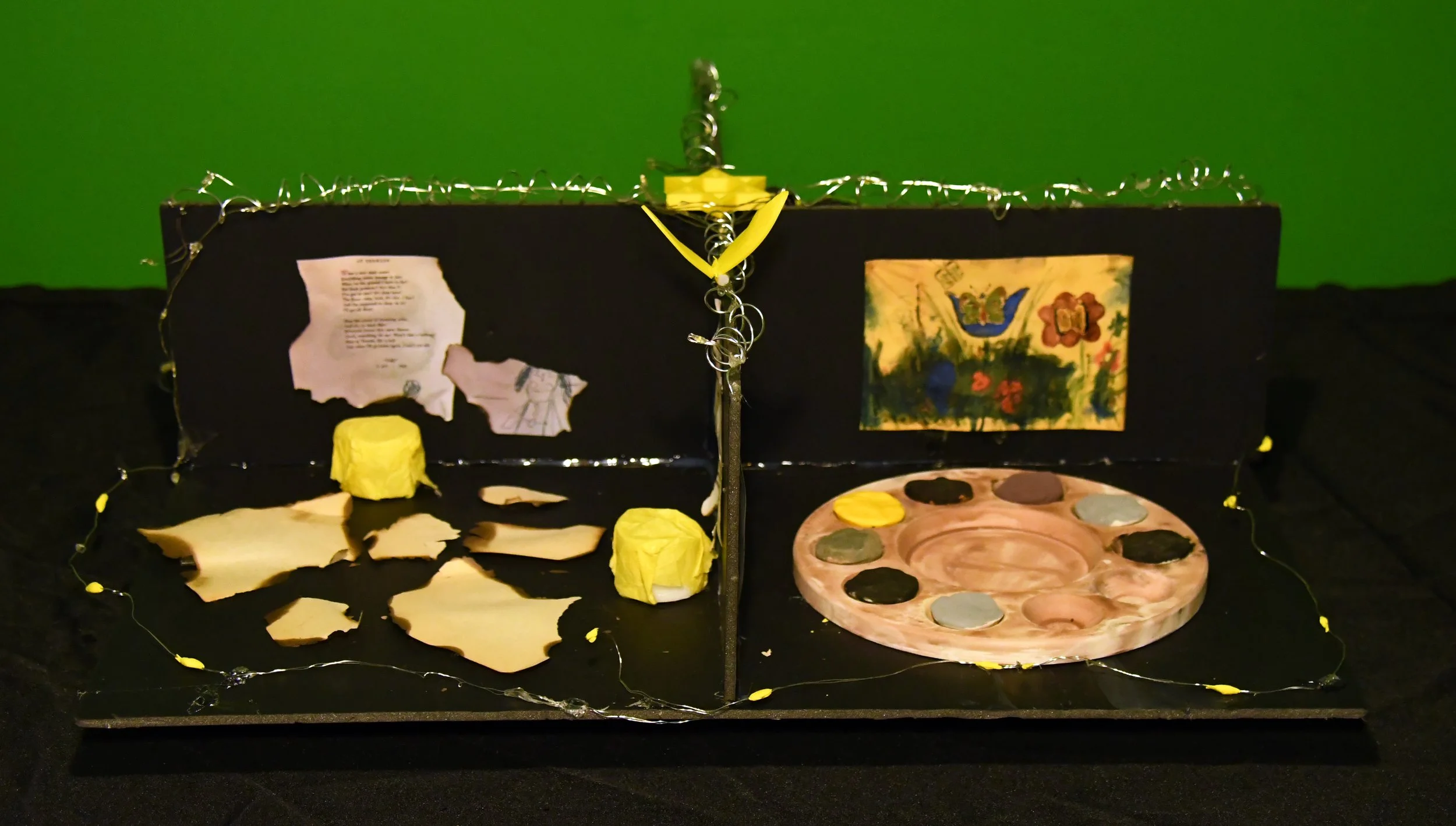
Nazi’s campaigned to obstruct free speech. In May 1933, Nazi university students gathered in Berlin’s Opernplatz and burned over 25,000 books written by Jewish authors. People watched as books were thrown into massive fires and listened to speeches on “cleansing” German culture, attempting to erase all Jewish ideas and voices.
This story inspired our burning book. The flame inside the book represents the destruction of knowledge, but it also represents remembrance. Even though Nazis burned books, many works survived through diaries and poems written in ghettos, as well as memoirs about survivors experiences. The fire in our artifacts symbolizes both destruction and the light of memory still present today.
While Nazis burned books, jews still continued to express their emotions through words. In 1942, a young Jewish prisoner of the Terezín ghetto, Pavel Friedman, wrote the poem “The Butterfly”. In the poem, he describes seeing the last butterfly in the ghetto: “ That butterfly was the last one. Butterflies don’t live here, in the ghetto.” The butterfly symbolized beauty and freedom- things that no longer existed in the ghettos. Friedman later died in Auschwitz, but his poem survived.
The same peaceful representation of a butterfly is seen in the painting One Spring by Karl Bodek and Kurt Conrad Löw from 1941 which was made while they were imprisoned in the south french camp, Gurs. It depicts a yellow butterfly sitting on the barbed wire that separated Nazi occupied France with unoccupied Spain. It represents the hope of getting to the other side, and that even though things are terrible, beautiful things like butterflies still exist. Both of these stories inspired the yellow butterfly on the barbed wire. While it represents lost freedom, it also conveys the idea of survival because even though the creator died, his poem was not erased. The bright yellow also connects the bright yellow Star of David in the middle of our artifact.
Another powerful form of resistance during the Holocaust was visual art. Even though prisoners were deprived of basic freedoms, many continued to create drawings and paintings and expressed their memories, hopes, and identities. In the Terezín ghetto, an art teacher named Friedl Dickey-Brandeis secretly gave children art lessons. She encouraged them to draw their homes, dreams, and memories. Before she was deported to Auschwitz, she hid over 4,000 children’s drawings in suitcases. After the war these drawings were discovered. Many of the children did not survive but their artwork did.
This story inspired our paint pallet and artwork section. The darker colors represent confinement and suffering, while the one yellow paint represents hope. The palette represents how creativity and hope continued even in the darkest moments of the Holocaust. One of the paintings displayed on the wall is “One spring” (1941), as mentioned before. The other painting "Butterfly” was created in the Terezín ghetto by a 10 year old Margit Koretz, a student of the art teacher Friedl Dicker-Brandies. It represents the hope, freedom, and the imagination of children living in the Terezín ghetto.
Throughout our memorial we used black poster board for the walls to create a feeling of confinement and darkness. The brown paint palette and violin stand out against the black background, creating slight contrast. The yellow symbols in each section created strong contrast against the brown and black elements, representing that bit of hope that still existed. The rough texture of the barbed wire represents the harsh conditions jews endured, while the lights represent the cultural pride that art brought to the prisoners.
Throughout our artifact we utilized the contrast between sorrow and anguish (dark colors) and the hope and joy (bright colors and lights). We used unity with the yellow and bright aspects to represent how prisoners’tried to transform terrible experiences through their creative expression of hope. The barbed wire texture reminds viewers that prisoners were confined in camps where they experienced constant suffering and oppression. Despite these harsh conditions, many prisoners secretly created art, poetry, and music, risking punishment in order to express themselves and preserve their identity.
Our memorial represents the idea that resistance can take on many forms. Creativity became a way for jewish people to preserve and protect their culture and identity at a time when everything else was stripped away from them. Our hope is that viewers will leave understanding that culture can survive even in the darkest of times. Working on this project helped us understand how important creativity and culture were for many Jewish prisoners. Learning about these stories showed us how people can maintain hope and identity even in the most difficult situations.
