Japanese American Internment
Created by Travis S., Leo A., Ashden D. & Oliver S.
How the United States government incarcerated Japanese-Americans after Pearl Harbor was attacked
(1941-1945)
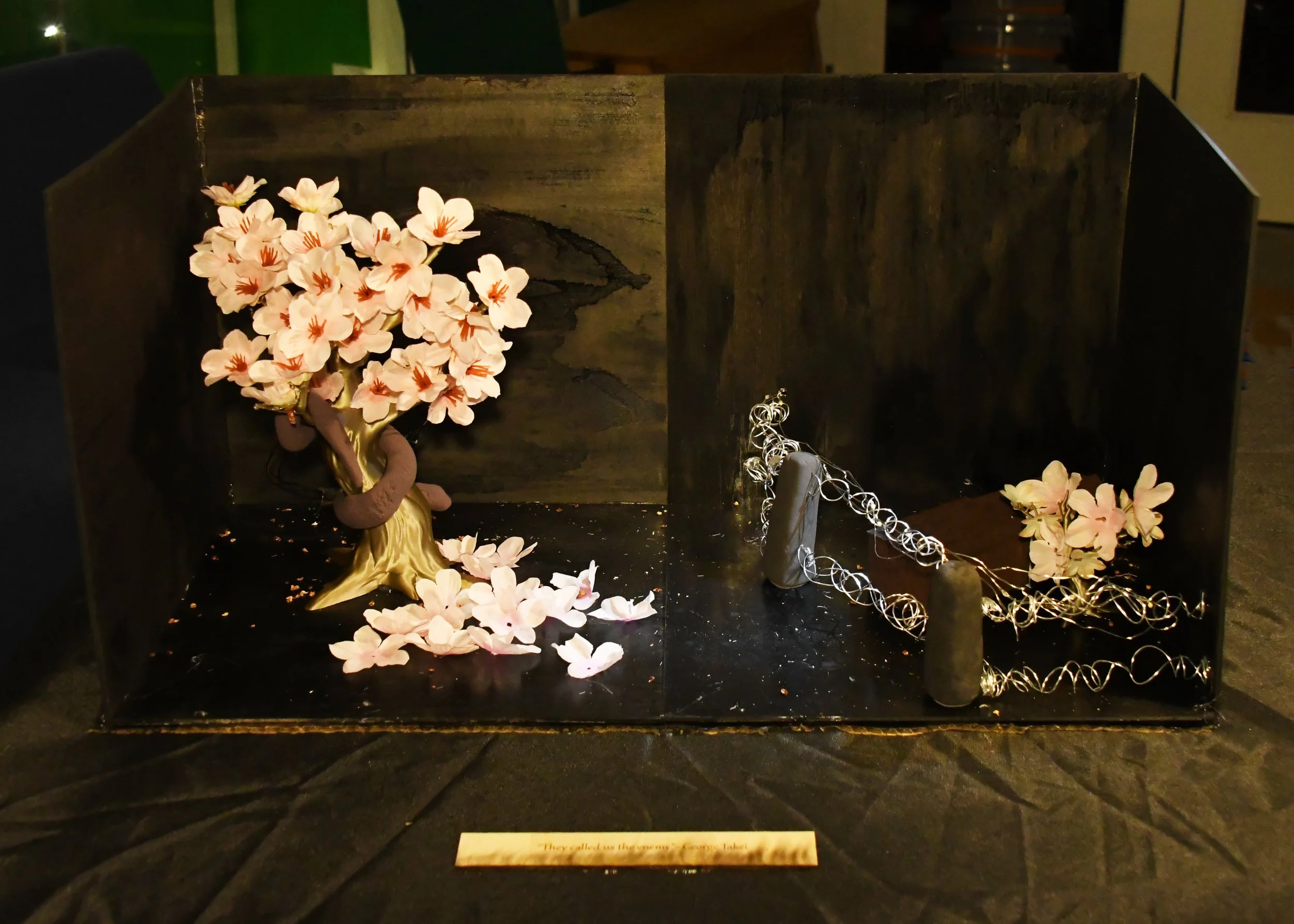
Encumbered Cherry Blossom
Artist Statement
Enveloped by barbed wire, a cherry blossom still grows. Entitled Encumbered Cherry Blossom, our artifact depicts an essential theme during Japanese American Internment: humanity in resistance. With this guiding idea, we evoked a sense of injustice and tentative hope, demonstrating the contrast between cultural preservation and incarceration.
Representing Japanese American Internment, this memorial communicates our core message that through traditions, culture can endure and withstand the most misguided attempts to erase it. After the bombing of Pearl Harbor, President Franklin Delano Roosevelt issued Executive Order 9066 on February 12th, 1942, leading to the relocation and incarceration of 120,000 Japanese Americans on the West Coast to squalid, supervised incarceration camps, such as Minidoka, Tule Lake, and Jerome, between the years 1942 and 1946. In crafting this piece, we aimed to convey a subtle message, inviting thoughtful reflection and nuanced interpretation. Specifically, small details, such as the delicacy of the cherry blossoms, serve to provoke deeper contemplation of the meaning behind every choice.
To express these ideas, we used symbols. Acting as the core symbol of our artifact, the cherry blossom tree symbolizes Japanese life in the United States, an experience rooted in the cultivation of the burgeoning culture in Japanese communities. Particularly, the fragility of the tree’s blossoms represents individuals and small communities. Moreover, some flowers have fallen between the internment camp, depicted on the right, and the base of the tree; those blossoms represent the Japanese Americans who were forced to leave their communities for internment camps. Coiled around the tree, the snake symbolizes the American government that restricted Japanese Americans to internment camps, specifically representing it through enveloping the cherry blossom tree—Japanese heritage—and facing toward the camp. Although not obvious upon first observation, the snake is cut on a portion of its body, exemplifying the “small cracks” or resistance of other Americans. This portrayal of opposition is subtle, as pervading anti-Japanese sentiment discouraged public defiance. Lastly, the nascent tree lying outside the barrack depicts internees’ resistance through cultural preservation: many prisoners “grew their own trees,” or continued Japanese customs. Namely, the art of gaman emerged in many internment camps, such as Tule Lake, where Japanese Americans created Japanese figurines and pins from salvaged shells, demonstrating their preservation of Japanese culture despite harsh conditions. Together, these symbols enhance the depth of the artifact’s interpretation: a viewer may argue that petals represent a fallen community, custom, or life regrown in the internment camps, while another viewer may construe the idea of diaspora and fragmented identity, only to be reforged with the remnants of its “past tree,” or heritage.
After planning our symbols, we considered how to construct them. We primarily used 3D printing or artificial items for the precise models—the tree, barrack, and blossoms—while utilizing Model Magic for pieces that required manual modification, such as the snake or small tree. Additionally, while designing, we had to pragmatically consider the tools we could build with, such as the 3D printer and Model Magic. We grappled with decisions about what items were actually essential to 3D print and what could be handmade, a method that allowed for easy alterations, which led to the snake being crafted with Model Magic. To resolve conflicting ideas, we discussed and hand-built, if possible, the proposed model to observe whether quality would be hindered, which did not occur in the case of the snake.
Once the forms were decided, we incorporated our elements of art: we used color to illustrate contrast. Pink, the color of a cherry blossom’s petals, represents gentleness and hope due to its lighter hue, while dark purple, the color of the snake, evokes fear, danger, and despair, furthering the dichotomy between hope and oppression and the resonance of our symbols. We also used light to create emphasis on the tree, which guides the viewer to observe the snake and the petals first, inferring meaning and subsequently perceiving the internment camp.
Through its symbolism and thoughtful design, our artifact serves as a reminder of Japanese American Internment and how powerful prejudicial fear can drive a nation to strip its citizens of their liberties and how that same nation can later attempt to minimize or overlook its past. Therein lies the importance of remembering history and Japanese American Internment.
